
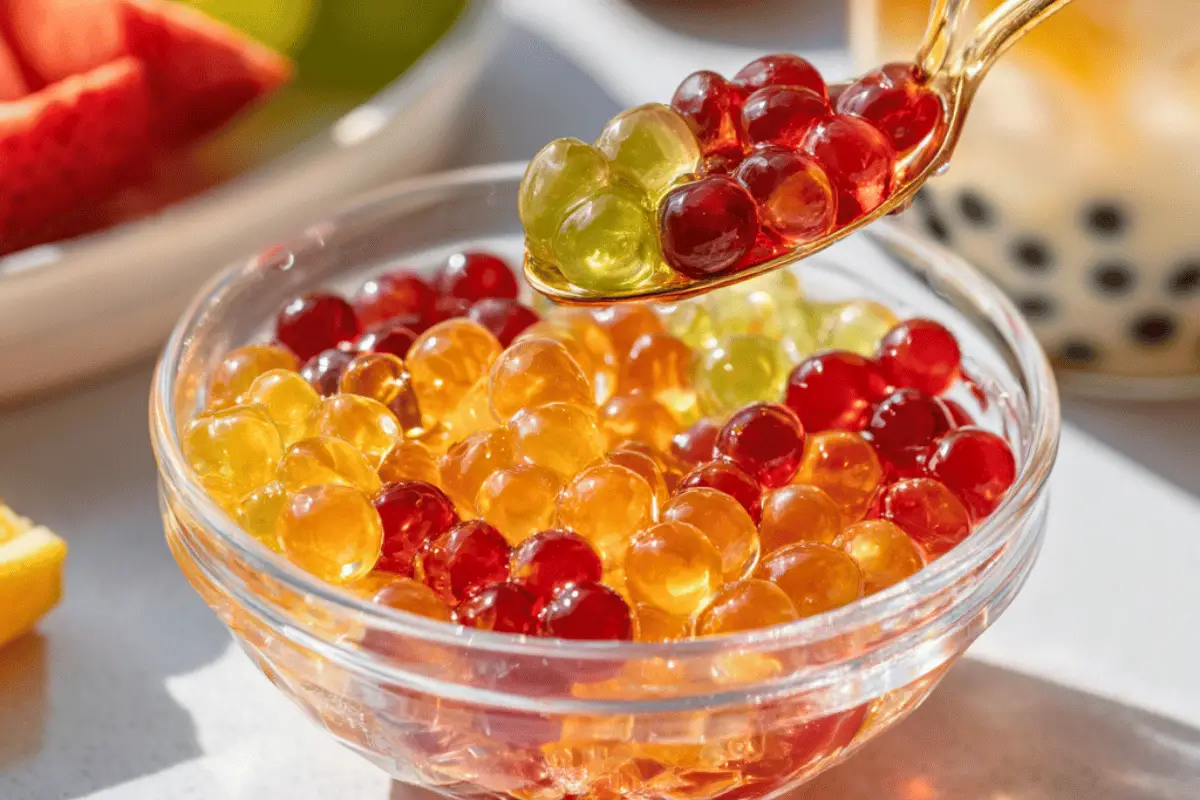
Have you ever bitten into a bubble tea and been delighted by the juicy pop of those little flavor-filled pearls? Those are called popping boba, and the good news is — you can make them right at home!
This recipe uses the basic spherification technique, a culinary method where fruit juice is turned into edible pearls that “pop” in your mouth. It may sound like magic, but it’s actually simple science — thanks to ingredients like sodium alginate and calcium lactate, you can transform juice into bouncy, juice-filled spheres with a burst of flavor.
The method is surprisingly easy and endlessly fun — ideal for bubble tea, ice cream toppings, mocktails, or just edible play. And because you can use your favorite fruit juice (think mango, watermelon, lychee, or even lemonade), the flavor combinations are infinite.
Why Make Popping Boba at Home?
1. Fully Customisable
Choose your favourite:
- Juice flavours (watermelon, lychee, mango, lemonade)
- Colours (use food colouring for vibrant boba)
- Sweetness level
2. Educational & Scientific
- Demonstrates molecular gastronomy
- Explores concepts like ion exchange, viscosity, and gel formation
- Makes science fun for kids and adults alike
3. Budget-Friendly & Fresh
Buying popping boba can be expensive — and store-bought often includes artificial flavouring and preservatives. This method uses:
- Fresh juice
- Minimal ingredients
- No fancy equipment
4. Fun & Interactive
This activity is perfect for:
- DIY bubble tea parties
- Cooking experiments
- Kids’ science crafts
- Creative dessert toppings
Ingredients & Tools
Ingredients (Basic Recipe – Makes ~¾ cup boba pearls):
Juice Mixture:
- 1 cup fruit juice (strained, no pulp – e.g. watermelon, mango, lychee, passionfruit)
- 1–2 Tbsp sugar or sweetener (optional, depending on juice sweetness)
- ½ tsp sodium alginate
- Optional: gel food colouring or flavour extract (to enhance colour or flavour)
Calcium Bath:
- 2 cups cold water
- 1 tsp calcium lactate or calcium chloride
Tools You’ll Need:
- 2 bowls (one for the calcium bath, one for a plain water rinse)
- Squeeze bottle, dropper, or syringe
- Fine mesh strainer or slotted spoon
- Extra bowl of cold water (to rinse boba and stop reaction)
Step-by-Step Instructions
Let’s break it down into simple steps — no advanced lab skills required!
1: Prepare the Juice Mixture
- Pour 1 cup of fruit juice into a blender or mixing cup.
– Make sure it is well-strained and free of pulp, which can affect consistency. - Add 1–2 Tbsp sugar or sweetener, if desired. Blend or stir to dissolve.
- Sprinkle in ½ tsp sodium alginate slowly while blending to prevent clumping.
- Blend for about 30 seconds until fully combined.
Let this mixture sit for at least 15–30 minutes to remove air bubbles.
2: Prepare the Calcium Bath
- In a clean bowl, combine 2 cups cold water with 1 tsp calcium lactate or calcium chloride.
- Stir until fully dissolved. This is your activation bath.
3: Drop & Spherify!
- Fill a squeeze bottle, dropper, or syringe with your juice mixture.
- Slowly squeeze small drops into the calcium bath, one by one.
- Watch the magic happen — each drop turns into a perfect little sphere within seconds!
Tip: Move the dropper close to the surface to prevent splashes or misshaped pearls.
4: Let Them Set
- Let the pearls sit in the bath for 30–60 seconds.
- The longer they stay, the thicker the outer “skin” will become.
- For thin-shelled popping boba, stick to 30 seconds.
5: Strain and Rinse
- Use a slotted spoon or fine mesh strainer to scoop out the pearls.
- Immediately transfer to a bowl of cold water to rinse off excess calcium.
- Swirl gently, then drain.
6: Store or Serve
- Use popping boba immediately in drinks or desserts
- Or store in a light sugar syrup in the fridge for up to 24–48 hours
- Avoid long-term storage as the texture will degrade
Creative Variations & Flavour Ideas
Make your boba pop with new flavours, colours, and uses!
Flavour Combos
| Juice | Optional Add-Ins |
|---|---|
| Watermelon | Mint or lime zest |
| Lychee | Rosewater or coconut |
| Mango | Passionfruit or lemon |
| Lemonade | Raspberry puree |
| Green Tea | Honey & matcha powder |
Colour Themes
- Add blue food colouring for mermaid boba
- Use neon pink or purple for unicorn boba
- Try gold shimmer dust for party sparkle
Ways to Use Homemade Boba:
- Bubble tea (milk tea or fruit tea)
- Yogurt or parfaits
- Ice cream sundaes
- Lemonade or mocktails
- Gelatin desserts
- Smoothie bowls
What is Spherification?
Spherification is a technique from molecular gastronomy that uses sodium alginate (a seaweed-derived gelling agent) and calcium ions to form a soft, edible shell around liquid.
In this basic version (called reverse spherification), the alginate is in the liquid, and the calcium is in the bath. When drops of the liquid fall into the calcium solution, they instantly form spheres that resemble soft caviar or popping boba.
🎓 This method is safe, edible, and completely magical to watch — perfect for home science projects or culinary adventures!
Tips for Success
- Blend the juice and alginate thoroughly to avoid lumps.
- Resting the mixture removes air bubbles that could deform your pearls.
- Use a steady hand and let drops fall naturally into the bath to form perfect spheres.
- Always rinse pearls in cold water to remove bitterness from the calcium bath.
- Use low-calcium juices — high-calcium content (like orange juice) can cause premature gelling.
Storage
- Store pearls in simple syrup (1:1 sugar to water) in the fridge.
- Best enjoyed within 24 hours.
- Do not freeze — freezing ruins the gel texture.
- Do not store pearls in plain water for long periods — they may dissolve or harden.
⏱️ Time Overview
- Prep Time: 10 minutes
- Alginate Resting Time: 15–30 minutes
- Boba Forming & Rinsing: 15–20 minutes
- Total Time: 45–60 minutes
🧾 Nutritional Information (Per 2 Tbsp serving – Approximate)
- Calories: 35
- Carbs: 7 g
- Sugar: 6 g
- Fat: 0 g
- Protein: 0 g
- Sodium: 10 mg
Nutrition will vary based on juice used and sweetener added.
Frequently Asked Questions
Q: Where can I buy sodium alginate and calcium lactate?
A: You can purchase both from specialty food stores, baking supply shops, or online retailers like Amazon. They’re often sold in molecular gastronomy kits.
Q: Can I use powdered drink mix instead of juice?
A: Yes! As long as it’s low in calcium and fully dissolved. Strain before adding alginate to ensure smoothness.
Q: Why are my spheres flat or not forming?
A: You may have under-hydrated alginate or dropped the mixture too quickly. Let the alginate rest and use a slower squeeze.
Q: Is this safe for kids to eat?
A: Yes! All the ingredients used are food-grade and safe to consume. Adult supervision is recommended during preparation.
Q: What’s the difference between popping boba and tapioca pearls?
A: Tapioca pearls are chewy and made from starch. Popping boba has a liquid centre and a soft gel shell, formed using a scientific process — and they burst in your mouth!
Conclusion
Now that you know how to make popping boba at home, you can bring the fun and flair of your favourite bubble tea shop right to your kitchen. This basic spherification method is the perfect blend of science and creativity — and the possibilities for flavour, colour, and presentation are nearly endless.
Whether you’re jazzing up a drink, topping off a dessert, or showing your kids how science can be delicious, popping boba is your gateway to culinary magic.
Print
How to Make Popping Boba at Home (Using Basic Spherification)
- Total Time: 45–60 minutes
Ingredients
Ingredients & Tools
Ingredients (Basic Recipe – Makes ~¾ cup boba pearls):
Juice Mixture:
- 1 cup fruit juice (strained, no pulp – e.g. watermelon, mango, lychee, passionfruit)
- 1–2 Tbsp sugar or sweetener (optional, depending on juice sweetness)
- ½ tsp sodium alginate
- Optional: gel food colouring or flavour extract (to enhance colour or flavour)
Calcium Bath:
- 2 cups cold water
- 1 tsp calcium lactate or calcium chloride
Tools You’ll Need:
- 2 bowls (one for the calcium bath, one for a plain water rinse)
- Squeeze bottle, dropper, or syringe
- Fine mesh strainer or slotted spoon
- Extra bowl of cold water (to rinse boba and stop reaction)
Instructions
Step-by-Step Instructions
Let’s break it down into simple steps — no advanced lab skills required!
1: Prepare the Juice Mixture
- Pour 1 cup of fruit juice into a blender or mixing cup.
– Make sure it is well-strained and free of pulp, which can affect consistency. - Add 1–2 Tbsp sugar or sweetener, if desired. Blend or stir to dissolve.
- Sprinkle in ½ tsp sodium alginate slowly while blending to prevent clumping.
- Blend for about 30 seconds until fully combined.
Let this mixture sit for at least 15–30 minutes to remove air bubbles.
2: Prepare the Calcium Bath
- In a clean bowl, combine 2 cups cold water with 1 tsp calcium lactate or calcium chloride.
- Stir until fully dissolved. This is your activation bath.
3: Drop & Spherify!
- Fill a squeeze bottle, dropper, or syringe with your juice mixture.
- Slowly squeeze small drops into the calcium bath, one by one.
- Watch the magic happen — each drop turns into a perfect little sphere within seconds!
Tip: Move the dropper close to the surface to prevent splashes or misshaped pearls.
4: Let Them Set
- Let the pearls sit in the bath for 30–60 seconds.
- The longer they stay, the thicker the outer “skin” will become.
- For thin-shelled popping boba, stick to 30 seconds.
5: Strain and Rinse
- Use a slotted spoon or fine mesh strainer to scoop out the pearls.
- Immediately transfer to a bowl of cold water to rinse off excess calcium.
- Swirl gently, then drain.
6: Store or Serve
- Use popping boba immediately in drinks or desserts
- Or store in a light sugar syrup in the fridge for up to 24–48 hours
- Avoid long-term storage as the texture will degrade
- Prep Time: 10 minutes
- Alginate Resting Time: 15–30 minutes
Nutrition
- Calories: 35
- Sugar: 6 g
- Sodium: 10 mg
- Fat: 0 g
- Carbohydrates: 7 g
- Protein: 0 g